


DEMETER R&D Center at the Department of Physics
The DEMETER (DEtector & Matter at Extremes TEst and Research) Center is a new R&D laboratory at the UZH Department of Physics, working on new key technologies that will allow us to "harvest muons generated at the next-generation muon source currently being installed at the Paul Scherrer Institute for new frontier particle physics and material science experiments.
Through DEMETER, we will also contribute to the new NCCR Muoniverse that UZH is co-hosting together with the Paul Scherrer Institute.
Background: IMPACT at the Paul Scherrer Institute
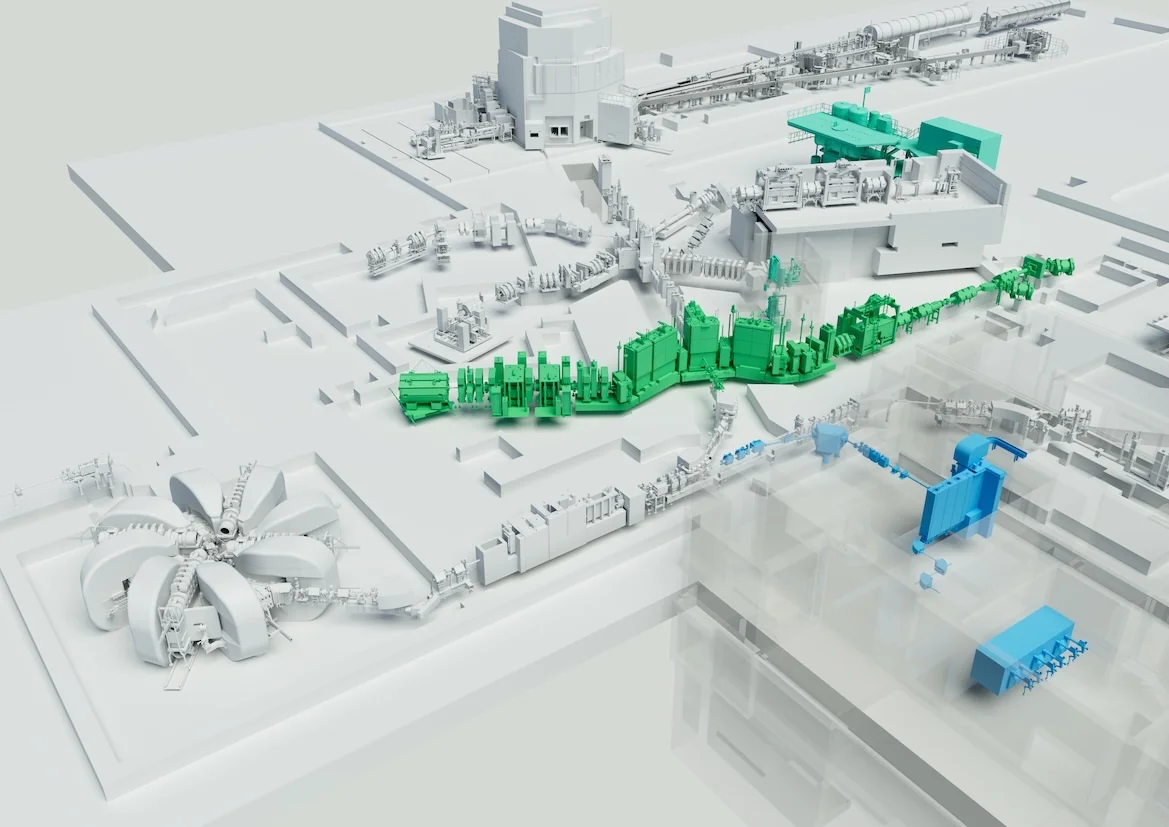
IMPACT ("Isotope and Muon Production using Advanced Cyclotron and Target technologies") is a major research infrastructure project part of the 2023 dispatch of the Swiss Roadmap for Research Infrastructures funded by the Swiss State Secretariate for Education, Research and Innovation. IMPACT consists of two major parts:
- The upgrade of the muon production facility SµS with a high-intensity muon beam (HIMB) target for substantial advancements in particle physics as well as in material science with muons.
- the implementation of a new production facility for rare isotopes for medicine “Targeted Alpha Tumor Therapy and Other Oncological Solutions” (TATTOOS).
Because UZH (together with the University Hospital Zurich, USZ) has major expertise in all three of these areas the application for IMPACT was submitted jointly between PSI, UZH and USZ. The project has formally started on January 1, 2025, and will run throughout 2030.
For the UZH Department of physics HIMB is of particular relevance to enable future research directions. After completion, HIMB will deliver a continuous low momentum muon beam with 1010 µ/s. Such a beam will be unique world-wide and will allow us to carry out novel, so-far impossible experiments that will push the current boundaries in high-precision particle physics, condensed matter physics and material science. In particle physics, the muon rates that are currently achievable limit the study of rare processes in the context of searches for charged lepton flavor violation. This limit will be removed by HIMB allowing researchers to look for physics beyond the standard model of particle physics via high-precision experiments that ideally complement efforts at the high-energy particle physics frontier pursued at CERN. In condensed matter physics and material science, HIMB will enable muon spin spectroscopy experiments on 10-100 times smaller sample sizes compared to the current state-of-the-art, allowing the study of materials’ transient behavior, an increase in throughput, the study of new regions of the phase space and devices.
DEMETER Organisation and Goals

So that UZH and PSI scientists, as well as Swiss and international users, may take full advantage of HIMB, new technology needs to be implemented. The UZH Department of Physics holds key expertise to make progress with this goal. As part of UZH's engagement in IMPACT/HIMB a new R&D Center — the so-called DEtector & Matter at Extremes TEst and Research (DEMETER) Center — was funded for the period 2025-2028 by the UZH Central Department forStrategic Research Platforms and consolidates these activities in new laboratories. Specifically, DEMETER scientists will work on two key technologies for HIMB, which we describe in more detail below.
Development of Pixelated Detectors
To exploit the increased rate of muons provided by HIMB, a new generation of detectors is required. In developing such instrumentation, as well as exploiting the fundamental physics measurements it produces, the UZH Department of Physics ’s groups in experimental particle physics (Caminada, Canelli, Kilminster, Serra) have built precision silicon detectors for the CMS and LHCb experiments at CERN and are currently engaged in researching the next generation of detectors with improved position and timing resolution for measuring charged-particle trajectories. With regard to experiments at PSI, these new pixelated detectors would provide the technology to take full advantage of the substantially increased muon flux delivered by HIMB.
For detector development DEMETER is currently building up clean room facilities that specialize in silicon detectors with precise timing and position resolution. Such detectors will provide key technologies for muon-based experiments at PSI’s HIMB facility as well as CERN’s HL-LHC and future particle collider programs.
Development of new high-pressure cells
The combination of the high-rate muon beam of HIMB at PSI with the new detectors developed at UZH will enable a new generation of muon spectroscopy experiments on materials with a 10-100 x smaller sample size as compared to the current state-of-the-art. This is particularly suited for realizing muon experiments at the extremes of high pressure. Muon spectroscopy experiments at the extremes of pressure have been very successful to investigate novel quantum materials, and new pressure cells reaching up to 30 GPa will establish an entirely new frontier for exploring quantum materials.
The UZH Physics Institute’s condensed matter groups have vast expertise in making and studying quantum materials (Chang, Janoschek, Natterer, Nordlander), where they have already developed a new generation of uniaxial pressure cells for small samples for synchrotron and neutron experiments (Chang/ Janoschek). Such pressure cells are equally suitable for muon spectroscopy. For DEMETER a new pressure laboratory is currently being outfitted that will provide new facilities to design and test pressure cells, as well as to perform off-beamline high-pressure characterization capabilities.
Find out more about the DEMETER high pressure efforts here: DEMETER-HP
Synergistic Integration of Detector and High-Pressure Developments
The DEMETER Center explicitly colocates development of detectors and high-pressure equipment as a strategic path to synergistically combine the expertise of detector development by the particle physics groups and high-pressure development from the condensed matter groups.