Characterization of the 2" Hamamatsu photomultiplier tube in cold xenon published
The characterization work carried out by our group on a new photosensor model manufactured by Hamamatsu has been published in JINST
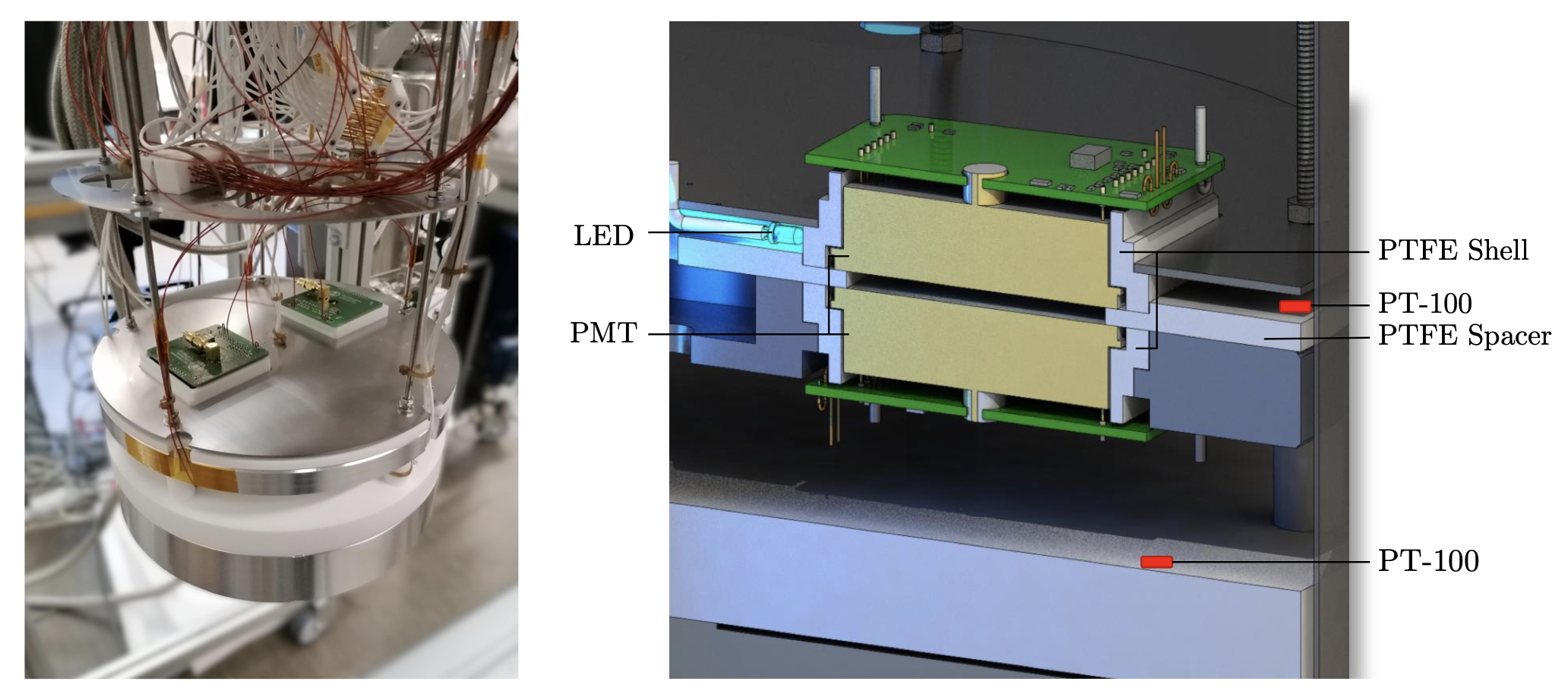
Time Projection Chamber detectors using xenon (gas and liquid) as active target are widely used in direct dark matter detection experiments. These detectors use photosensors (typically photomultiplier tubes) to detect light signals generated in the xenon. However, these experiments are constantly evolving and increasing in size with each new phase: for example, the future detector of the XLZD collaboration will be a cylinder 3 m in diameter and 3 m high, operating with approximately 80 t of xenon. This opens the door for other types of photosensors to be more suitable under these conditions in contrast to the traditionally used tubes.
The new photomultiplier tube (PMT) model 12699-406-M4 manufactured by Hamamatsu has been characterized in a joint work with our collaborators from Nikhef (Amsterdam). This new photosensor is flatter compared to the previously used PMTs and mechanically more stable under these conditions. In this work, published in JINST, several 2" PMTs have been tested in liquid xenon under pressure and temperature conditions similar to those of existing experiments.