Research
Our research program is centered on genuine quantum phenomena in bulk materials that arise due to collective electronic behavior. These electronic correlations strongly couple spin, charge and lattice degrees of freedom resulting in emergent and rich low-energy physics. We study so-called quantum materials where such collective quantum phenomena at the atomic-scale are borne out in functional macroscopic properties that often hold promise for future applications, ranging from power management and transmission, to platforms for quantum computation, to novel versatile sensors and electronics. We are particularly interested in understanding how tuning of the underlying quantum interactions via external control parameters (pressure, field, strain, crystal chemistry) may be used to control and optimize the properties of quantum materials. For this purpose, we probe quantum matter with state-of-the-art spectroscopy at large-scale neutron, photon and muon facilities.
A short video describing our research at CNM can be found here.
Research Topics
Below we provide a selection of research topics in which we are actively working on in the Correlated Quantum Matter Group.
Table of contents
Topological Magnetism

We investigate materials that exhibit magnetic ground states characterized by a topologically non-trivial spin textures such as skyrmions. Magnetic skyrmions are nanoscale spin-configurations that possess particle-like character associated with a topological winding number and exhibit highly unconventional transport properties such as the topological Hall effect. These exotic topological properties are not only of broad interest for fundamental research but may also be exploited for the design of novel data-storage and spintronic devices.
We are particularly interested in understanding the underlying interactions that stabilize these functional magnetic ground states. We predominantly use neutron spectroscopy to study the magnetic excitations that both encode these interactions but may also have interesting functional or topological properties themselves. Further, we use neutron and resonant x-ray diffraction methods to characterize novel topological phases or understand how they may be tuned. Finally, we also exploit bulk methods to directly test their functionality.
Key publications :
- Unusual magnetism of the axion-insulator candidate Eu5In2Sb6, Phys. Rev. B 109, 174404 (2024), M. C. Rahn, M. N. Wilson, T. J. Hicken, F. L. Pratt, C. Wang, F. Orlandi, D. D. Khalyavin, P. Manuel, L. S. I. Veiga, A. Bombardi, S. Francoual, P. Bereciartua, A. S. Sukhanov, J. D. Thompson, S. M. Thomas, P. F. S. Rosa, T. Lancaster, F. Ronning, and M. Janoschek
- Topological magnon band structure of emergent Landau levels in a skyrmion lattice, Science 375, 6584 (2022), T. Weber, D. M. Fobes, J. Waizner, P. Steffens, G. S. Tucker, M. Böhm, L. Beddrich, C. Franz, H. Gabold, R. Bewley, D. Voneshen, M. Skoulatos, R. Georgii, G. Ehlers, A. Bauer, C. Pfleiderer, P. Böni, M. Janoschek, and M. Garst.
- Skyrmion Lattice Creep at ultra-low Current Densities, Nature Communication Materials 1, 83 (2020) Yongkang Luo, Shizeng Lin, M. Leroux, N. Wakeham, D. M. Fobes, E. D. Bauer, J. B. Betts, J. D. Thompson, A. Migliori, M. Janoschek, Boris Maiorov.
- Fluctuation-induced first-order phase transition in Dzyaloshinskii-Moriya helimagnets, Phys. Rev B 87, 134407 (2013), M. Janoschek, M. Garst, A. Bauer, P. Krautscheid, R. Georgii, P. Boni, and C. Pfleiderer
Quantum Phase Transitions

Unlike classical phase transitions, which are driven by thermal fluctuations and characterized by a competition between internal energy and entropy at finite temperatures, quantum phase transitions occur at absolute zero and are triggered by zero-point fluctuations. Consequently they cannot be accessed using temperature as control parameter but can be reached by tuning a non-thermal parameter—such as pressure, magnetic field, or chemical composition.
As established in the pioneering work of Hertz and Millis, quantum phase transitions differ fundamentally from their thermal counterparts because the Heisenberg uncertainty principle inextricably couples the system’s spatial fluctuations with its temporal evolution. For thermally driven critical points (second order phase transitions) occurring at a finite temperature T the order parameter fluctuations may be characterized by a relaxation frequency spectrum Γ~(1/ξ)z, where the dependence on the correlation length ξ defines the dynamical exponent z. When the transition temperature is approached the correlation length ξ diverges, signaling the onset of order. The simultanuously vanishing fluctuation frequency Γ, in turn, results in the so-called ‘critical slowing down’ at the critical point (11). Consequently, only the lowest-lying parts of the fluctuation spectrum, so-called soft modes, define the behavior at the phase transition.
When the fluctuations become much faster than the temperature of the system (ħΓ > kBT), they are classified as quantum fluctuations, implying that quantum critical fluctuations are only relevant for T = 0. However, as first pointed out by Hertz and Millis for Quantum Critical Points (QCPs) driven by a nonthermal control parameter such as pressure, magnetic field or chemical substition, critical slowing down does not imply a quantum to classical crossover at finite temperatures. In contrast, the quantum effects lead to a strong coupling of spatial and temperature order parameter fluctuations that can be viewed as increasing the dimension of the system by the dynamical exponent, deff=d+z and affect the system up to finite temperatures.
Frequently, the quantum fluctuations present at a quantum phase transition result in the emergence of novel quantum states. We study magnetic quantum phase transitions arond which novel behavior and phases such unconventional superconductivity arise. We use neutron spectroscopy with the highest available energy resolution as well as bulk measurements to study quantum fluctuations and the quantum phases emerging close to quantum criticality.
Key publications:
- Magnetic Field Dependence of Critical Fluctuations in CeCu5.8Ag0.2, Phys. Rev. B 113, 045154 (2026), X. Boraley, A. D. Christianson, J. Lass, C. Balz, M. Bartkowiak, Ch. Niedermayer, J. M. Lawrence, L. Poudel, D. G. Mandrus, F. Ronning, M. Janoschek, and D. G. Mazzone
- A microscopic Kondo lattice model for the heavy fermion antiferromagnet CeIn3, Nat. Comm. 14, 8239 (2023), W. Simeth, Z. Wang, E. A. Ghioldi, D. M. Fobes, A. Podlesnyak, N. H. Sung, E. D. Bauer, J. Lass, J. Vonka, D. G. Mazzone, C. Niedermayer, Yusuke Nomura, Ryotaro Arita, C. D. Batista, F. Ronning, and M. Janoschek
- Ultrahigh-resolution neutron spectroscopy of low-energy spin dynamics in UGe2, Phys. Rev. B 99, 014429 (2019)., F. Haslbeck, S. Säubert, M. Seifert, C. Franz, M. Schulz, A. Heinemann, T. Keller, Pinaki Das, J. D. Thompson, E. D. Bauer, C. Pfleiderer, M. Janoschek
- Quantum critical scaling in the disordered itinerant ferromagnet UCo1-xFexGe, Phys. Rev. Lett. 117, 237202 (2016), K. Huang, S. Eley, P. F. S. Rosa, L. Civale, E. D. Bauer, R. E. Baumbach, M. B. Maple, and M. Janoschek
Strong Electronic Correlations

A long-standing focus of the correlated quantum matter group has been to study quantum phenomena in bulk materials that arise due to collective electronic behavior. Here we particularly focus on electrons at the border of localization, which are known to generate exotic states of matter across all classes of strongly correlated electron materials and many other quantum materials with emergent functionality. Heavy electron metals are a model example, in which magnetic interactions arise from the opposing limits of localized and itinerant electrons. This remarkable duality is intimately related to the emergence of a plethora of novel quantum matter states such as unconventional superconductivity, electronic-nematic states, hidden order and most recently topological states of matter such as topological Kondo insulators and Kondo semimetals and putative chiral superconductors. We are particularly interested in understanding this behavior quantitatively by carrying out detailed high-resolution spectroscopy studies using advanced neutron or X-ray spectrometers at large-scale neutron and photon facilities.
Key Publications:
- Connection between f-electron correlations and magnetic excitations in UTe2, npj Quantum Mater. 10, 2 (2025), T. Halloran, P. Czajka, G. Saucedo, C. Frank, C.-J. Kang, J.A. Rodriguez-Rivera, J. Lass, Daniel G. Mazzone, M. Janoschek, G. Kotliar, and N. Butch
- A microscopic Kondo lattice model for the heavy fermion antiferromagnet CeIn3, Nat. Comm. 14, 8239 (2023), W. Simeth, Z. Wang, E. A. Ghioldi, D. M. Fobes, A. Podlesnyak, N. H. Sung, E. D. Bauer, J. Lass, J. Vonka, D. G. Mazzone, C. Niedermayer, Yusuke Nomura, Ryotaro Arita, C. D. Batista, F. Ronning, and M. Janoschek
- Kondo quasiparticle dynamics observed by resonant inelastic x-ray scattering, Nat. Comm. 13, 6129 (2022), M. C. Rahn, K. Kummer , A. Hariki , K.-H. Ahn , J. Kuneš , A. Amorese , J. Denlinger , D. Lu , M. Hashimoto, E. Rienks, M. Valvidares, F. Haslbeck , D. Byler, K. McClellan , E. D. Bauer, J.-X. Zhu, C. Booth, A. Christianson , J. M. Lawrence , F. Ronning, and M. Janoschek
- Tunable Emergent Heterostructures in a Prototypical Correlated Metal, Nature Physics 14, 456–460 (2018), David M. Fobes, S. Zhang, S.-Z. Lin, Pinaki Das, N. J. Ghimire, E. D. Bauer, J. D. Thomson, L. W. Harriger, G. Ehlers, A. Podlesnyak, R. I. Bewley, A. Sazonov, V. Hutanu, F. Ronning, C. D. Batista, M. Janoschek
- The Valence-Fluctuating Ground State of Plutonium, Science Advances 1, e1500188 (2015), M. Janoschek, Pinaki Das, B. Chakrabarti, D. L. Abernathy, M. D. Lumsden, J. M. Lawrence, J. D. Thompson, G. H. Lander, J. N. Mitchell, S. Richmond, M. Ramos, F. Trouw, J.-X. Zhu, K. Haule, G. Kotliar, E. D. Bauer
Quantum Magnets
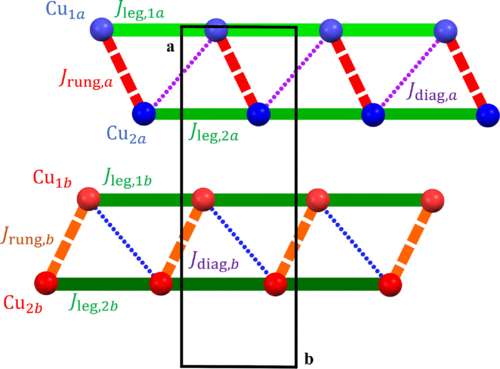
Low-dimensional insulating quantum magnets are model systems for studying the emergent many-body physics and collective excitations that can arise even in systems with only short-range interactions. Using neutron spectroscopy, we study their low-temperature spin Hamiltonians in order to explain their exotic magnetic properties, including unconventional quantum phases, phase transitions, and excited states.
Key Publications:
- Magnetic and phononic dynamics in the two-ladder quantum magnet (C5H9NH3)2CuBr4, Accepted for publication in Phys. Rev. B, J. Philippe, F. Elson, T. Arh, S. Sanz, M. Metzelaars, D. W. Tam, O. K. Forslund, O. Shliakhtun, C. Jiang, J. Lass, M. D. Le, J. Ollivier, P. Bouillot, T. Giamarchi, M. Bartkowiak, D. G. Mazzone, P. Kögerler, M. Månsson, A. M. Läuchli, Y. Sassa, M. Janoschek, B. Normand, G. Simutis
- (C5H9NH3)2CuBr4: a metal-organic two-ladder quantum magnet, Phys. Rev. B 110, 094101 (2024), J. Philippe, F. Elson, M. P. N. Casati, S. Sanz, M. Metzelaars, O. Shliakhtun, O. K. Forslund, J. Lass, T. Shiroka, A. Linden, D. G. Mazzone, J. Ollivier, S. Shin, M. Medarde, B. Lake, M. Mansson, M. Bartkowiak, B. Normand, P. Kögerler, Y. Sassa, M. Janoschek, and G. Simutis