13.07.2026: Transformer Models Improve Pulse-Shape Discrimination in HPGe Detectors
Transformer-based models outperform a feature-based baseline for pulse-shape discrimination in Majorana Demonstrator HPGe waveforms, with masked-autoencoder pre-training reducing the need for labelled data by factors of 2-4 in low-label regimes. Marta Babicz and collaborators published the study in Machine Learning: Science and Technology, showing how modern sequence-learning methods can use the full information contained in digitised detector waveforms.
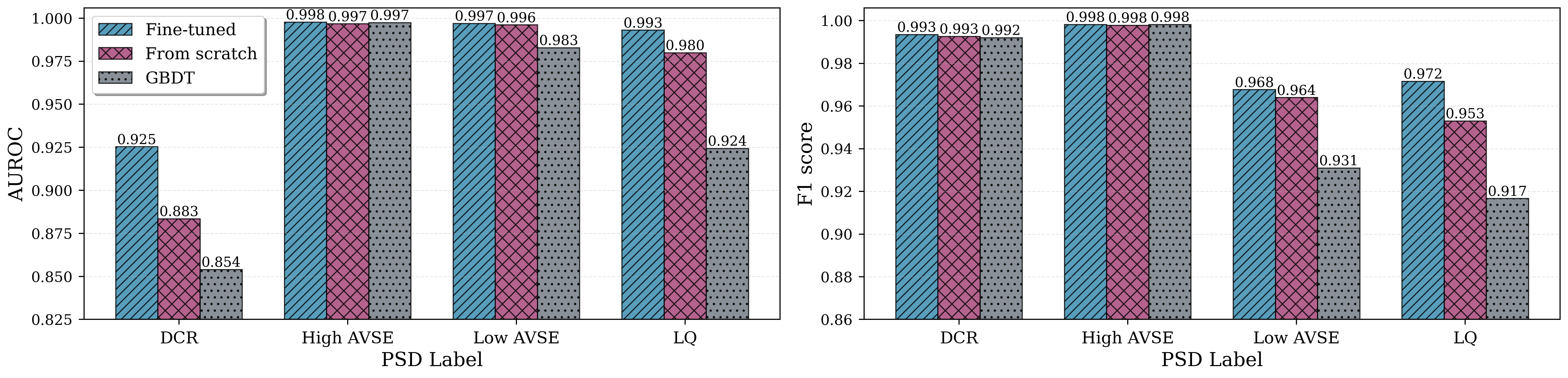
Pulse-shape discrimination is a key tool in rare-event searches such as neutrinoless double-beta decay, where HPGe detectors must distinguish candidate signal-like events from backgrounds. Instead of compressing each waveform into a few hand-crafted summary quantities, the study trains detector-conditioned transformer models directly on charge traces and their gradients from the Majorana Demonstrator AI/ML data release. The transformers improve classification performance across standard PSD selections, especially for the more challenging labels and for the combined PSD-pass definition. The work also shows that self-supervised masked-autoencoder pre-training on unlabelled calibration data can make the models substantially more sample-efficient, an encouraging result for future applications in LEGEND-200, LEGEND-1000, and other HPGe-based low-background experiments.
You can read the paper in Machine Learning: Science and Technology, and the preprint is available as arXiv:2603.06192.