Bio- and Medical Physics

Table of contents
Prof. Christof Aegerter - Disordered and biological soft matter

We study the properties of disordered and heterogeneous systems out of equilibrium. One aspect of this general theme that we study encompasses light transport in turbid media and photonic glasses, with applications in imaging, structural colours, light harvesting for energy and secure optical communication. A second focus of our activities is the study of macroscopic non-equilibrium systems and their coarse grained hydrodynamics. Examples of this are the clustering of granular gases or the coarsening of foams, as well as Faraday instabilities of surface waves in liquids. In all these fields our investigations are mainly experimental, developing the tools necessary, e.g. to study rheology in levitated foams, however we also use computational modeling to guide these experiments.
Creation of highly scattering photonic glasses and their characterization
Light transport in disordered media can be described by a diffusive process, where the light diffusion is described by a transport mean free path and a transport speed. If the particles making up the disordered medium are monodisperse particles of a size comparable to the wavelength of the light used, Mie-scattering leads to resonant behaviour that can lead to a strong increase in the scattering cross-section, as well as a decrease in transport velocity. Furthermore, the mean free path (and the scattering cross-section) are strongly influenced by the refractive index contrast of the particles and their surroundings. In the description of the transport properties of photonic glasses, all of these effects have to be taken into account in addition to the fact that the surrounding medium has to be described by an effective refractive index as well, given by the filling fraction of the particles.
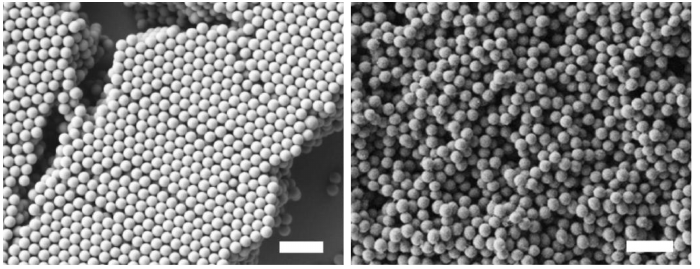
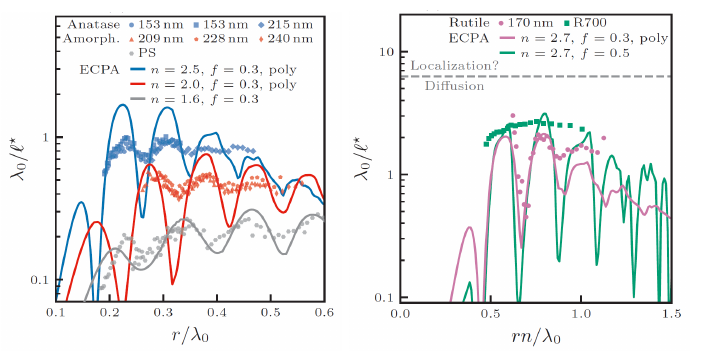
In collaboration with the Polarz group, we have synthesised colloidal particles of TiO2 , with a refractive index depending on the crystal structure ranging from 2.0 (amorphous), to 2.5 (anatase), to 2.7 (rutile), see Fig. 1. By adding salts, the synthesis can be controlled to lead to monodisperse particles that do not form crystals, such that we are able to produce photonic glasses at different refractive indices with monodisperse particles. These samples, we have then studied using coherent backscattering, which gives a clear experimental determination of the mean free path of these samples. Performing the experiments with a tunable laser source to vary the wavelength, also allows us to study the resonance properties of the combination of Mie-scattering with an effective medium approximation. The results of such model calculations are in good agreement with the experiment, see Fig. 2, showing that the transport process in photonic glasses is well understood and that the systhesis method does indeed produce the designed for particles.
-

- Zoom
- Fig. 1: (Left) a sample of almost monodisperse TiO2 nanospheres forming a colloidal crystal. (Right) TiO2 nanospheres of a similar size, also almost monodisperse, however the addition of CaCl precludes the formation of a colloidal crystal and rather leads to the formation of a glass. The scale bar indicates 2μm.
-
-

- Zoom
- Fig. 2: (Left) transport mean free path for different samples at different wavelengths. (Right) transport mean free path for two highly scattering rutile samples.
-
Highlighted Publications:
- Stochastic Resonance in Noisy Optical Resonators Modeled Through Coupled-Mode Theory,
V. Mazzone and C.M. Aegerter;
Communications in Nonlinear Science and Numerical Simulation (2025).
http://dx.doi.org/10.2139/ssrn.4312925.
Prof. Uwe Schneider - Medical Physics and Radiation Research (Hirslanden)

We are conducting research and development in Medical Physics, Theoretical Biology and Medical Modelling. Our main topics are: Development of radio-biological models, space radiation research, Monte Carlo simulations and dosimetry for radiotherapy and imaging and the development of novel detector systems.
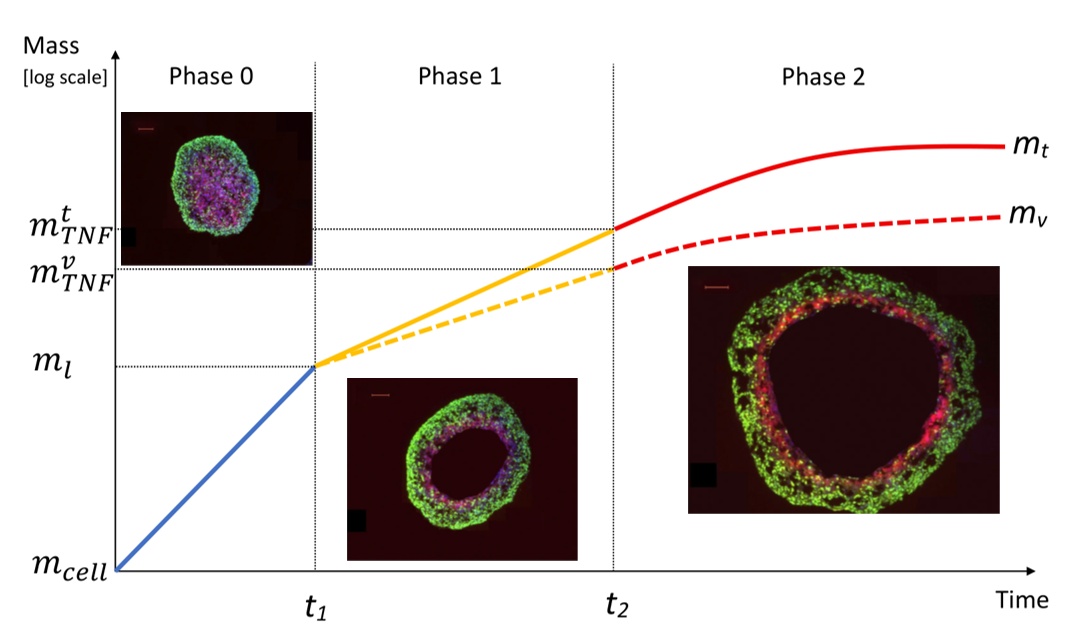
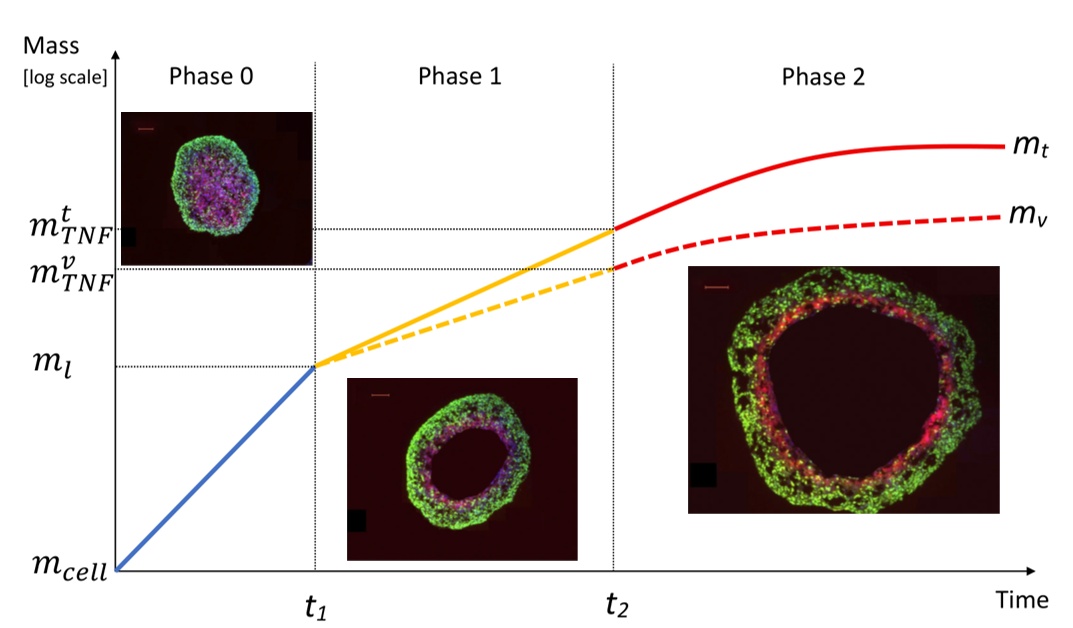
In 2025, we developed a novel model to estimate the probability of tumor control following radiotherapy and successfully applied it to breast cancer [1]. In addition, we established a new model describing tumor spheroid growth (Figure) and their radiation response. Using our nanodosimetry detector, we also successfully measured the diffusion and mobility of propane ions in the parent gas experimentally [2].
-
- Zoom
- Qualitative growth curves for total (mt) and viable (mv) tumor spheroid mass during three modeled growth phases. The onset of necrosis at t1 and the transition to growth inhibition at t2 are indicated.
Highlighted Publications:
- Poisson Linear-Quadratic Tumor Control Probability Model Validation in Micro- and Macroscopic Breast Cancer Radiation Therapy.
S. Unterkirhers, S. Erni, G. Gruber, U. Schneider,
Int J Radiat Oncol Biol Phys. 2025:S0360-3016(25)06482-X,doi: 10.1016/j.ijrobp.2025.11.008 - Diffusion and mobility measurements for propane gas with a nanodosimetric detector.
I. Kempf, U. Schneider,
Radiation Physics and Chemistry. 2025 Volume 226:112274, doi.org/10.1016/j.radphyschem.2024.112274
Prof. Jan Unkelbach - Medical Physics (University Hospital Zurich)

Radiotherapy is one of the mainstays of cancer treatment and a highly technology-driven field of medicine. In our research group, we contribute to the further development of radiotherapy technology by applying concepts from physics, mathematics, statistics, and machine learning to problems in medical imaging and radiation oncology.
We focus on three areas of research:
1) Radiotherapy treatment planning: We work on mathematical optimization methods to optimally combine x-ray and proton beams, and to optimally distribute radiation dose over multiple treatment days and radiation modalities.
2) Target delineation and outcome prediction: Here, we focus on quantitative modeling of tumor progression and the analysis of medical images such as MRI, CT, and PET, with the goal of precisely defining the region to be irradiated and predicting the patient’s response to treatment (see Figure).
3) Latest radiotherapy technology: We perform research on MR-guided adaptive radiotherapy at the MR-Linac, a combination of MRI scanner and radiotherapy device that allows MR imaging of a patient during treatment.
-

- Zoom (PNG, 92 KB)
- Figure: Modeling of lymphatic metastatic progression of head & neck cancer using statistical machine learning techniques [1]
Highlighted Publications:
- Modelling the lymphatic metastatic progression pathways of OPSCC from multi-institutional datasets.
R. Ludwig et al., Sci Rep. 14(1):15750, 2024.
Prof. Ben Schuler - Molecular Biophysics (Department of Biochemistry)


We study the structure, dynamics, and functions of biomolecules, especially proteins, the nanomachines of life. Towards this goal, we develop and apply single-molecule fluorescence and force spectroscopy, often in close combination with theory and simulations. A particularly important tool is Förster resonance energy transfer (FRET), a spectroscopic nanoscale ruler.
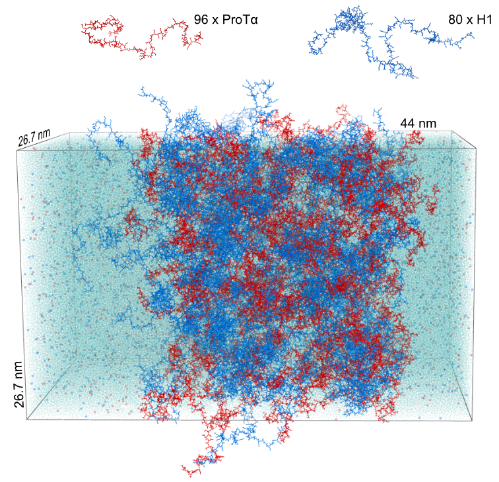
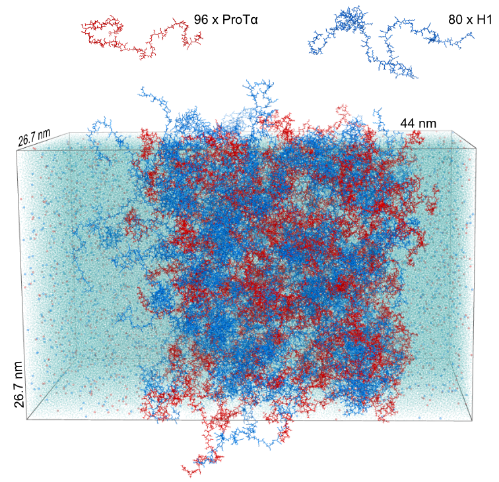
A highlight was the investigation of biomolecular condensates formed by phase separation of proteins, where the combination of single-molecule fluorescence experiments and large-scale simulations enabled us to mechanistically link nanoscopic and mesoscopic properties of these materials [1].
-
- Zoom
- Illustration of a large-scale molecular dynamics simulation of a biomolecular condensate formed from two highly charged proteins. We investigated the nanoscopic dynamics of such systems with single-molecule fluorescence spectroscopy and related them to their mesoscopic viscoelasticity [1].
Highlighted Publications:
-
Material properties of biomolecular condensates emerge from nanoscale dynamics,
N. Galvanetto et al.,
Proc. Natl. Acad. Sci. USA 122, e2424135122