A well-understood starting point
Conventional superconductors
Electrons form pairs, helped by vibrations of the atoms. This provides a successful explanation for many superconducting materials.
Superconductors · Try it yourself
Below a critical temperature, a superconductor carries a DC current with zero electrical resistance.
What makes electrons behave this way? That is a question you could help explore.
Above 90 K, this example has electrical resistance. Slide left to cool it down.
An idealised example with a transition at 90 K, not a measurement of a specific material. Real transitions can be broader; the normal-state resistance scale is arbitrary.

Bachelor’s & Master’s projects / Superconductors
A vanishing resistance is just the beginning. Explore the patterns, waves and electron interactions behind superconductivity—and find a question for your thesis.
01 / The idea in a minute
In an ordinary wire, electrical resistance turns some energy into heat. Cool a superconductor below its transition temperature and its DC electrical resistance drops to zero.
Its magnetic behaviour changes too. Magnetic field can be pushed out of its interior—the Meissner effect. Under the right conditions, a magnet can even float above it.
How can countless electrons create one shared quantum state? And why do some materials do this at much higher temperatures than others?

A well-understood starting point
Electrons form pairs, helped by vibrations of the atoms. This provides a successful explanation for many superconducting materials.
Open questions to explore
Families such as cuprates and nickelates bring harder questions. Magnetism, electron interactions and charge patterns offer clues, but the full story is still being worked out.
02 / The questions we ask
Charge order: electrons can form a repeating pattern of higher and lower density. How does that pattern relate to superconductivity?
Spin waves: the tiny magnetic moments of electrons can move collectively. Comparing these waves in cuprates and nickelates reveals clues about electron interactions.
Strain and magnetic field: a small squeeze or an applied field can change the balance between different states. We watch what responds—and what does not.
Make an electron pattern
Change the strength and spacing of a charge pattern. Darker dots mean more electron density.
A static density sketch, not individual electron positions. This does not predict how strain, field or superconductivity change charge order; experiments test those relationships.
03 / A real research example
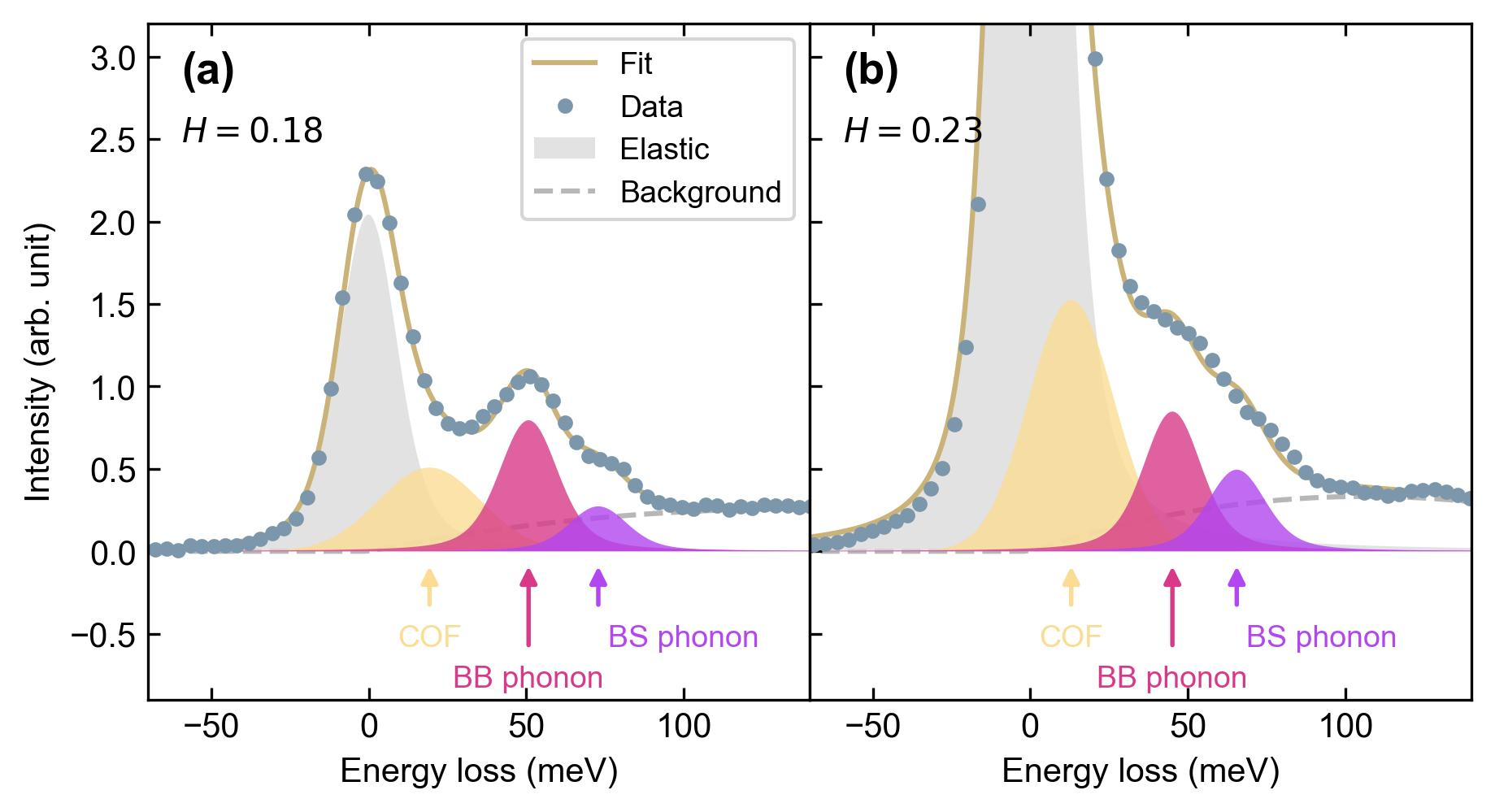
In our LESCO study, we separated overlapping signals from vibrations and charge motion. This let us follow a weak electronic feature whose energy changes with momentum.
A student project could start with this kind of detective work: fit the peaks, check the uncertainties, and find out which conclusions the data support.
Explore the study ↗Go a little deeper
These are research papers and resources, so they go beyond the short explanations above.
Visuals: AI-generated banner painting and concept illustration; these are artistic impressions. Research figure: Xunyang Hong and collaborators; local copy from the research showcase. Schematic demos are for explanation, not measured data.
Your next step
Come by the office Y36 H50 , look for Johan Chang and discuss a potential project. Bring your questions, your interests, or simply your curiosity.
Physik-Institut · Irchel campus
Winterthurerstrasse 190, Zürich