BRIDGE discovery project
Transferring state of the art optimisation methods from the natural sciences to supply chain decision making
This BRIDGE discovery project is a joint ETH-UZH multidisciplinary research initiative led by Fields Medalist Prof. Dr. Alessio Figalli and CERN and AI specialist Prof. Dr. Nicola Serra. The project aims to transfer advanced mathematical and scientific techniques into operational settings in logistics and supply chains. The research focuses on developing decision-support systems for recurring operational decisions affected by uncertainty, changing conditions, and imperfect data.
Why are operation decisions hard?
Operational decisions are difficult because organizations must act in environments that are uncertain, fast-changing, and operationally complex:
- Real-world operational data is often fragmented, noisy and inconsistent. This makes traditional AI and optimisation technques difficult to apply.
- Decisions usually involve trade-offs between competing objectives such as cost vs speed, or utilization vs customer service. This can make the 'best' decision subjective and dependent on context.
- Operational systems can generate a huge number of possible actions, making it difficult for humans to consistently identify the best option.
- Operational environments must continue functioning despite uncertainty, disruptions, and changing information.
- Human operators need transparency and control, so decision-support systems must remain explainable and practical to use in live environments.
As companies increasingly race to adopt AI to improve productivity and operational performance, many discover that existing AI approaches depend on lengthy and expensive data harmonization and integration before they can deliver value at scale.
Our approach
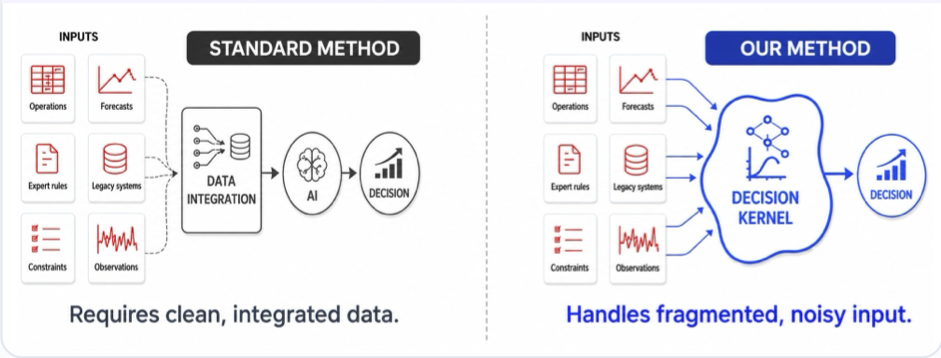
Our approach focuses on decision-support systems that can operate effectively in real-world environments where data is fragmented, noisy, and constantly evolving. Instead of requiring organizations to first complete large-scale data harmonization and integration projects, we develop methods that can work directly with imperfect operational inputs while still providing robust recommendations, clear trade-offs, and human oversight. This allows operational teams to make better decisions under uncertainty without depending on rigid pipelines or idealized data conditions. By combining mathematical optimization, machine learning, and human-in-the-loop decision support, the goal is to make advanced AI methods practical and usable within live operational settings.
Operational reality through industrial pilots
Research developed in isolation risks becoming impractical in real operational settings. In this BRIDGE project, we address this from the outset by developing the technology in close collaboration with industrial partners, where solutions are built around concrete operational decision problems. This allows the research to be continuously tested against real-world constraints, workflows, and performance requirements. The goal is that, as the BRIDGE project matures, the resulting decision-support system is ready for deployment in live operational environments.
![[Drawing of LHCb detector]](/dam/jcr:c725b6f5-1c46-44ec-9ace-891eec0b33d3/LHCbDetector.png)
![[Video]](/dam/jcr:41b84625-3522-4c7b-ab83-a2cbf323a66f/How_particle_physics_works_III.png)