 |
 |
| home |
| group |
| XENON1T.org |
| XENON100 internal |
| XENON100 wiki |
| ATP wiki |
| DARWIN |
| UZH physics |
XENON group at the University of Zurich |
||||||||||||||||||
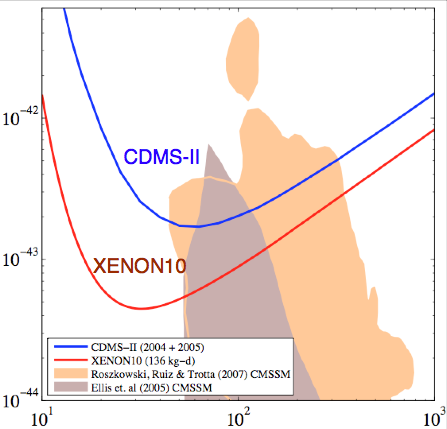
The XENON programXENON is a direct dark matter detection experiment using liquid xenon as the detector medium. The goal is to detect the small charge and light signal after a dark matter particle interacts with a xenon nucleus in a liquid-gas two-phase time projection chamber (TPC): The prompt light signal (S1) is detected with two array of photomultipliers. The ionization electrons are separated from the Xe ions and drifted upwards by a strong electric field. A second electric field extracts the charges from the liquid into the gas phase where they generate secondary scintillation light (S2) which is proportional to the charge signal. The secondary signal -- delayed to the S1 by the electron drift time -- is detected with the same two photodetector arrays.The TPC design allows the precise 3-dimensional reconstruction of the interaction vertex which can be used to reduce the background contamination by fiducial volume cuts. Furthermore, the ratio S2/S1 has a different value for electron recoils (background) and nuclear recoils (signal) and can be used for background discrimination. The first phase - XENON10 - has been successfully operated in dark matter mode at the Gran Sasso Underground Laboratory (LNGS) until 2007 leading to some of the best limits on WIMP dark matter so far.
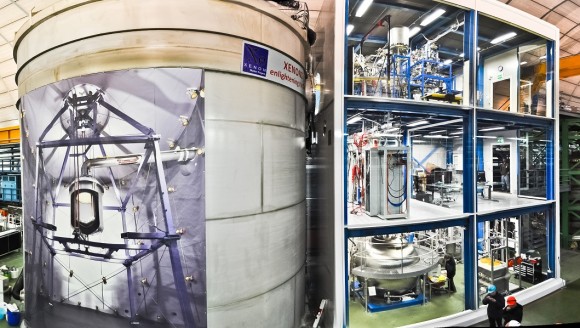
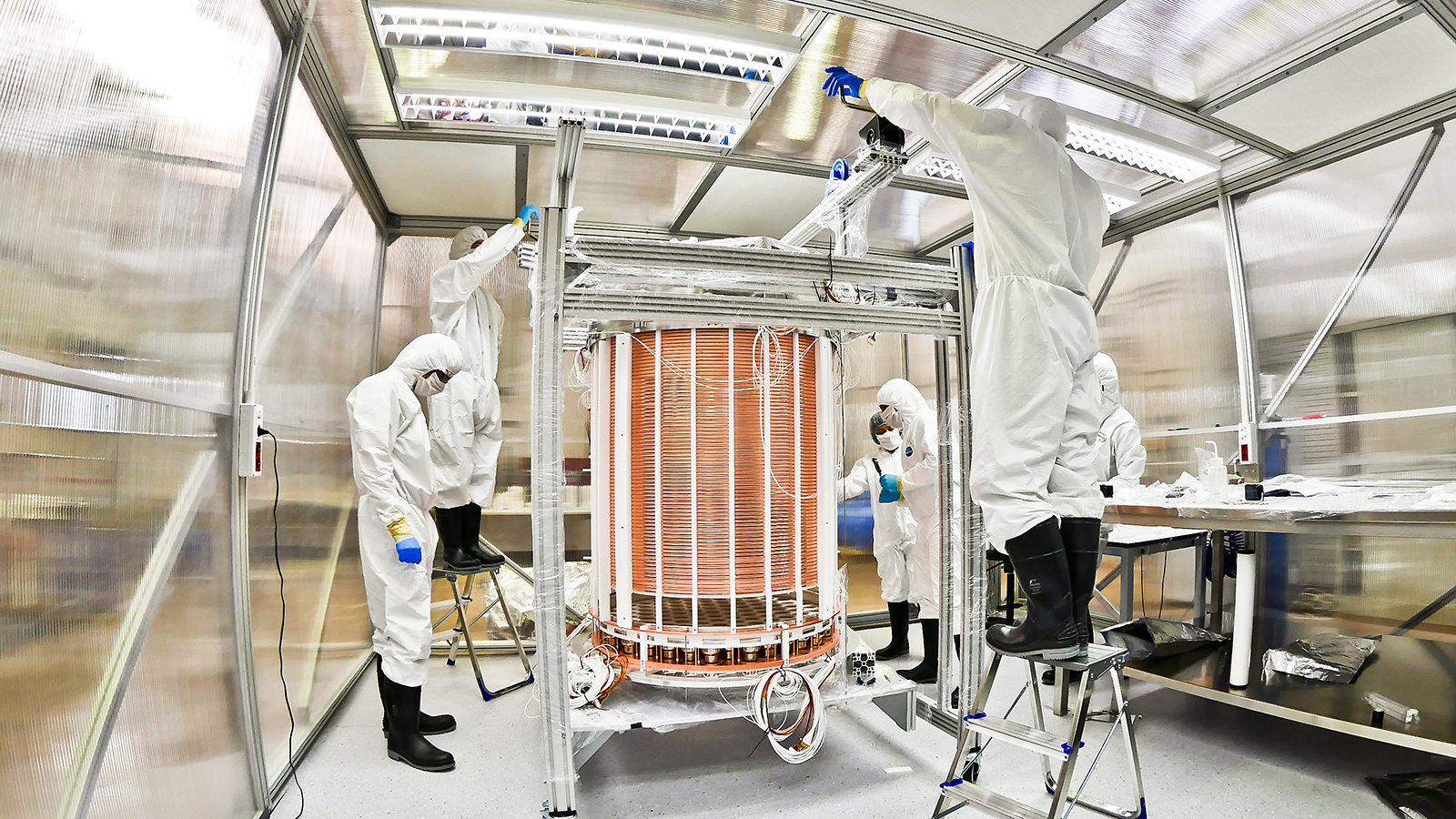
XENON1TXENON1T is one of the most ambitious ongoing dark matter search projects. It is a dual-phase LXe TPC with a total mass of ~3 t and a fiducial mass of ~1 t. In order to detect the VUV scintillation light from particle interactions with the xenon target, two arrays of 3-inch Hamamatsu R11410 photomultiplier tubes will be installed on the top and bottom of the TPC. We aim for a background of less than one event in 2 t-years exposure, leading to a sensitivity to spin-independent WIMP-nucleon scattering cross sections of 2×10-47 cm2 for 100 GeV/c2 WIMPs, two orders of magnitude below the sensitivity of XENON100 and a factor of 40 below the current best limits from the LUX and PandaX experiments.In order to reduce the ambient backgrounds to negligible levels, the XENON1T detector is placed inside a large water shield of 10 m height and 9.6 m diameter, instrumented with 84 8-inch Hamamatsu R5912 PMTs which provide an active Cerenkov veto and a shield against environmental radiation. The assembly of the water tank was already completed in Hall B at LNGS, and most other subsystems are currently under construction. The XENON1T detector with its Cherenkov muon veto, together with a picture taken during the TPC assembly are shown below:
Within the XENON1T project, we are co-leading several collaboration-wide working groups, working on Monte Carlo simulations, detector calibrations with UV light and radiactive sources, radioactive screening of detector components, characterization and testing of the photosensors, design of the the time-projection chamber, construction of the field cage, and cabling. The next step in the XENON dark matter search program is the XENONnT project. It will double the amount of xenon in the sensitive volume, which would allow to increase the fiducial mass and simultaneously provide a significant reduction of radioactive background. The XENONnT TPC with the inner cryostat vessel will be constructed while XENON1T is taking data, and will be installed in the same outer vessel and the water shield as XENON1T.
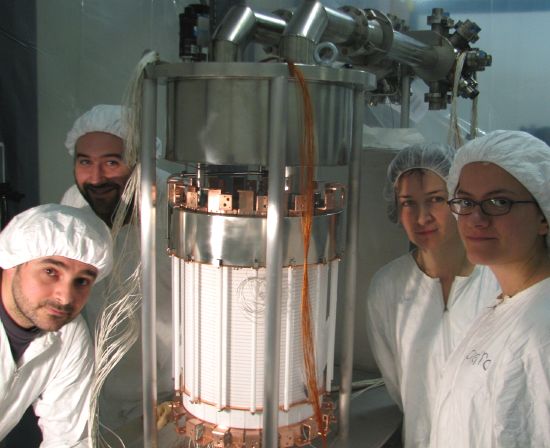
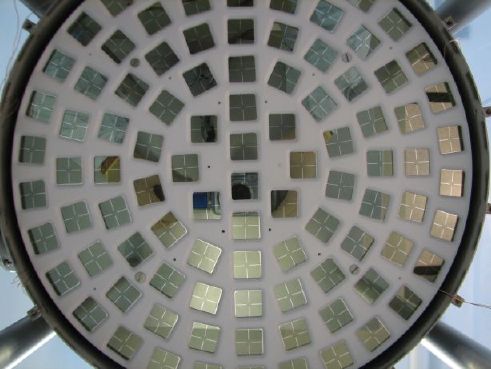
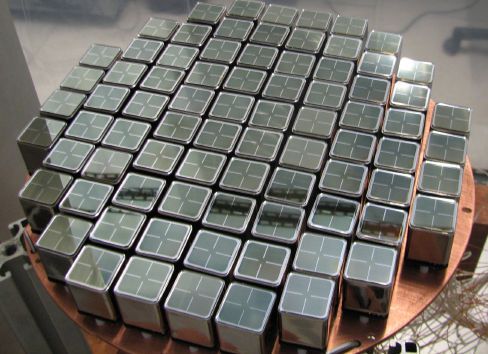
XENON100The scientific goal of the XENON100 experiment was to reach a WIMP sensitivity that is one order of magnitude better than its predecessor XENON10. This was achieved by an increase in target mass by one order of magnitude, up to 62 kg. At the same time, the gamma background was reduced by a factor 100. This was achieved by a careful selection of all detector materials for radiopurity and by an improved detector design.In order to reduce the background even further, the target volume is completely surrounded by a layer of liquid xenon (almost 100 kg in total). This shield utilizes the excellent self shielding capabilities of xenon, and, being instrumented with PMTs, provides further background reduction. The pictures show the XENON100 detector with some members of the UZH group during its installation, the top and bottom PMT arrays, as well as the closed detector in its shield:
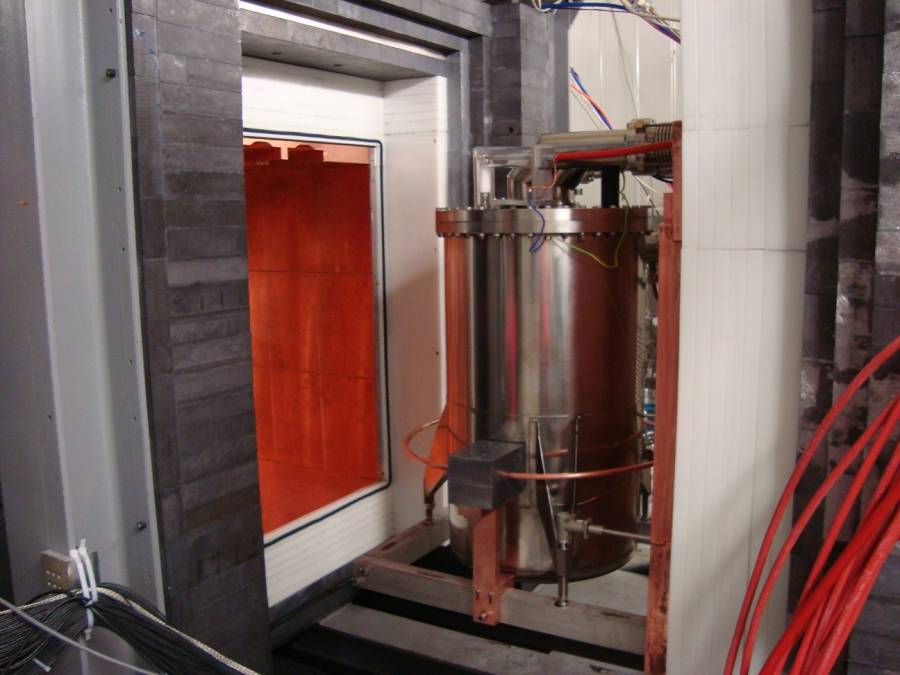
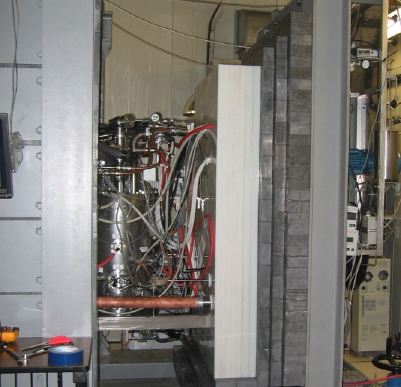
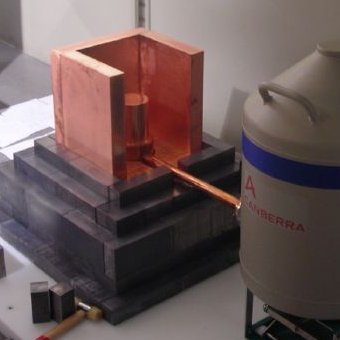
Our group was involved in PMT testing, calibration and operations at LNGS, in the construction of various detector and shield hardware components, in material screening with a high-purity Ge spectrometer, in data processing and analysis, in Monte Carlo simulations of the expected gamma, alpha, and neutron backgrounds, in the WIMP analysis for spin-dependent and spin-independent interactions, as well as in the design, construction and Monte Carlo simulations for the next phase. The results of WIMP searches with the 225 live days of data acquired with XENON100 have been published in (Phys. Rev. Lett. 109, 181301, 2012), for spin-independent interactions, and in (Phys. Rev. Lett. 111, 021301, 2013), for spin-dependent case. XENON10The picture shows the XENON10 detector in its low-background shield. Note the difference to XENON100, for which the cables, feed-throughs and cryo-cooler have been moved outside the shield.
Limits for spin-dependent WIMP nucleon interactions have been published in (Phys. Rev. Lett. 101, 2008). R&D and Lab Activities
Gator: low level counting
XENON in the news
|
||||||||||||||||||